
Introduction: A Discovery That Rewrote History
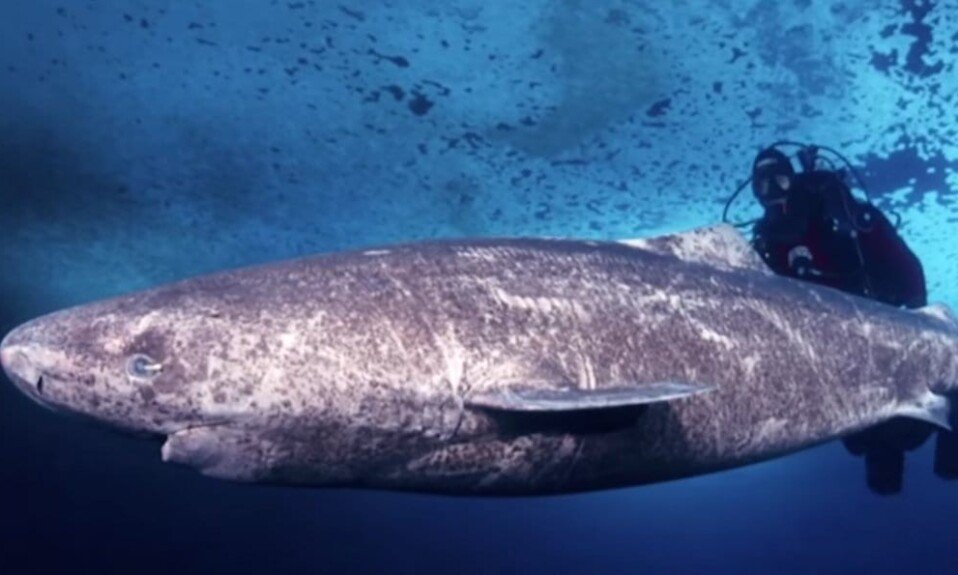
A few months ago, scientists discovered something in the frozen waters of the North Atlantic that shocked the scientific world. They had found a Greenland shark whose age was almost inconceivable. It is estimated that this single animal lived 512 years. It means it sailed the seas when Shakespeare was not even born and managed to live centuries during human history. Having made this discovery, the Greenland shark has acquired a new name as the oldest vertebrate in existence on Earth.
This is not just a record that was made. It prompted scientists to reconsider the issue of animal longevity, the mechanisation of ageing in harsh conditions, and the secrets that nature keeps at the depths of the ocean.
The Greenland Shark: A Silent Deepwater Giant
The Greenland sharks inhabit some of the darkest and coldest waters on Earth. They are slow in their movement, slow in growth, and their existence is far away, out of sight of human beings. They do not hunt, like the fast predators, but drift lazily through the Arctic and North Atlantic waters, energy-saving and living on a diversified diet.
Such sharks usually consume fish, seals, and even the carcass of polar bears. Their slowness of pace already led scientists to suspect that they had a longer life than most animals. Nevertheless, nobody anticipated that they would live more than half a millennium.
The Age of The Shark as Determined by Scientists
The age of a shark is a significant challenge. Sharks are not like trees, as they do not grow with distinct rings. Scientists have long used crude approximations based on body size. That was not very precise, particularly with animals which cease to grow at the same rate upon maturity.
A more dependable method was presented by marine biologist Julius Nielsen and his researchers. They examined the eye lenses of Greenland sharks. The lens tissue of the eye is developed before birth and remains unchanged throughout the animal’s lifetime. Scientists can determine the year of birth of a shark by measuring the radiocarbon levels within its lens.
This technique revealed that the oldest shark in the region likely appeared in 1505. The results were published in the journal Science and garnered worldwide attention.
Why The Age Estimates in The Past Were Not Sufficient
It had previously been presumed that Greenland sharks had a constant rate of growth, averaging 0.4 inches/year. Although that can be used to approximate the age of younger sharks, it no longer works when growth slows due to maturity.
Scientists confessed that for decades, they did not have clear answers. There was a long-held belief that Greenland sharks had a lifespan of just a few decades. Some thought they could live a few more centuries. This was a point of uncertainty, making the new research more important.
Its absence of knowledge was mind-boggling, as noted by Steven Campana, one of the foremost professionals. The Greenland shark is the largest predator in Arctic waters. However, scientists were unable to determine its age with certainty, whether it was 20 years or 1000 years. The novel approach eventually introduced a sense of clarity.
The Stagnant Growth and Pure Long Life
The growth of Greenland sharks is extremely slow. It is only at the age of about 150 that they become sexually mature. This gradual evolution contributes significantly to their longevity.
Their metabolism is also influenced by cold water. During the cold Arctic weather, the chemical reactions within the body operate slowly. This minimises cell destruction over time and could be the reason why these sharks do not age as quickly as animals in warmer climates.
Their splendid stamina is probably due in part to a sluggish metabolism, accompanied by little or no physical exertion.
Life In the Arctic Ocean
The environment of Greenland sharks is the Arctic, which significantly influences every aspect of their life. Cold water restricts bacterial growth, which minimises disease. Sharks are also safe in the deep sea because most predators, including humans, do not harass them.
These sharks frequently harbour parasites in their eyes, which can impair their vision. Nevertheless, they thrive very well. They depend on smell and are peaceful in behaviour, thus navigating the dark waters.
The life span of Greenland sharks is centuries long, so they do not stay in one place. Genetic analysis reveals that sharks in various oceanic regions share similar DNA. This implies that they must have originated from a familiar locality and gradually spread across the oceans over generations.
A Species Still Shrouded in Mystery
Despite this discovery, many aspects of the Greenland shark remain unknown. The modes of reproduction in them remain unknown to scientists. They are observed to prefer cold Arctic waters for breeding, but there has been little direct evidence.
They also have a long lifespan, which casts doubts on population growth. When sharks require more than a hundred years to reach maturity, the predator’s population might be susceptible to environmental changes and human activity.
It will be essential to understand how they reproduce to conserve and sustain their long-term survival.
The Implications of this Discovery to Science
This finding altered the way researchers consider ageing in vertebrates. The Greenland shark can now be regarded as a living example of extreme longevity.
Scientists assume that studying its genes can provide some hints regarding cell repair, disease resistance, and longevity. Scientists in Denmark, Greenland, the United States, and China are now sequencing the genome of the shark.
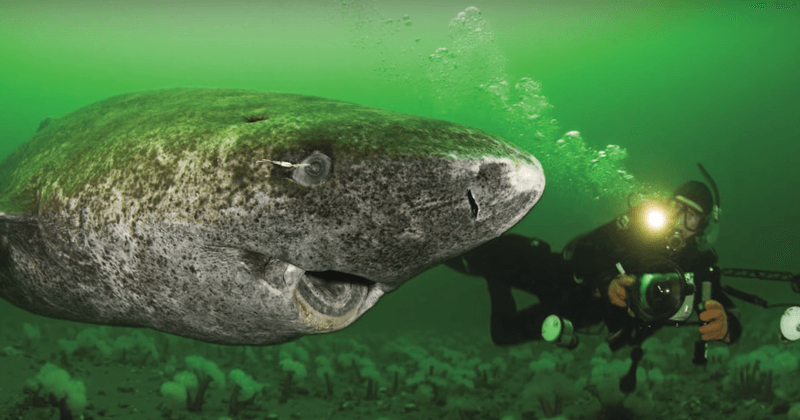
They are interested in discovering why this species outlives all other vertebrates and whether these mechanisms are also present in different animals.
The Long Life: Possible Reasons
Scientists continue to develop various theories as research progresses. Cold water probably retards metabolism. Minimal activity minimises physical attrition. Powerful cell repair mechanisms can defend tissues across centuries.
Julius Nielsen points out that these concepts are still theories. Further studies are needed to establish the contribution of each factor towards such a long life. However, the combination of environment, genetics, and lifestyle provides a strong reason.
Lessons of a 512-year-old Survivor
The Greenland shark teaches us that nature has its way. Speed, strength, and dominance are not always the keys to longevity. It is sometimes a result of patience, balance and adaptation.
This animal has survived ice ages, oceans and centuries of environmental changes. Its presence challenges the beliefs regarding the boundaries of life and paves the way for scientific marvels.
Conclusion
One of the most extraordinary discoveries of recent biology is the finding of a 512-year-old shark in Greenland. It redefined the concept of lifespan, ageing, and survival under harsh conditions.
The Greenland shark is a living record of the Earth’s history, as scientists continue to study the ancient species. Conserving it will ensure that future generations can continue to study one of the greatest survivors that nature has ever taught us.